Cutting problems
How to cut a problem that is too big to solve into pieces that can be solved and checked one at a time, and why this also shapes working with an AI.
What you will learn
Here you learn to cut a problem that is too big into pieces you can solve, and afterwards you can:
- explain what decomposition means using an everyday example such as planning a party
- use divide and conquer to find a number between 1 and 100 in at most seven yes/no questions, and narrow down a fault in a chain with a test in the middle
- solve a smaller version of a problem first and grow it from there step by step
- phrase a piece so that a built-in test says yes or no to whether it is done
- split responsibilities along clear borders and give an AI assistant small jobs that bring their own test
"Build a chat app" cannot be solved in one piece, by anyone. That says nothing about you; it is the normal state of every interesting problem. Big problems are not solved in one go: they are cut, again and again, until the pieces are small enough to be solved and checked.
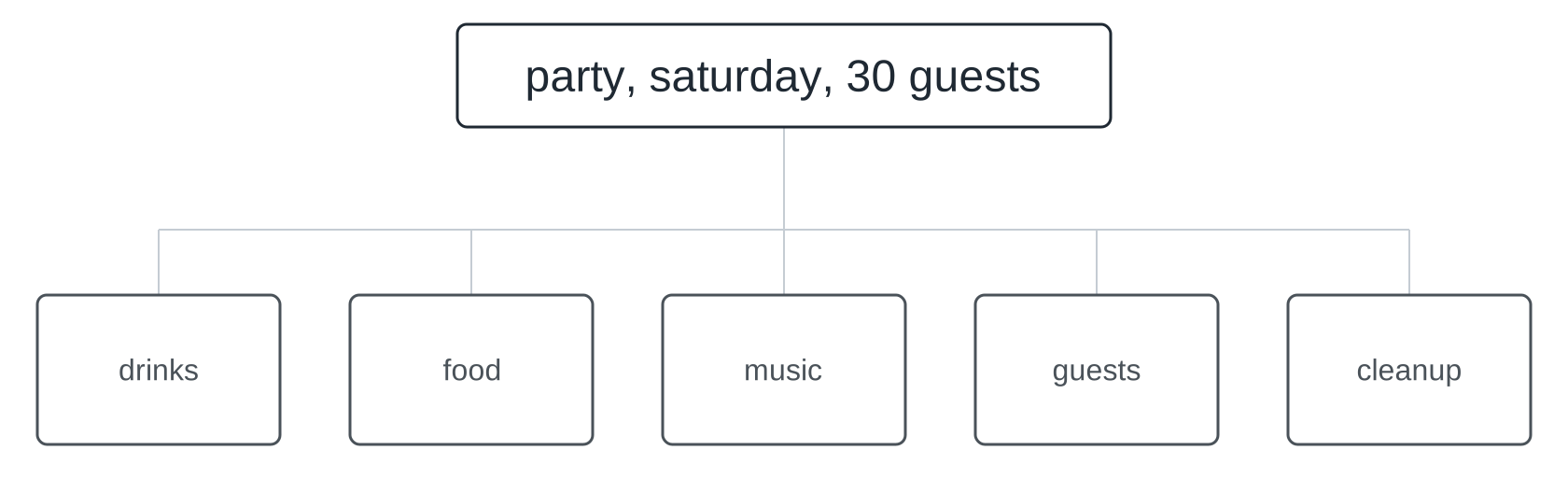
You can already do this, by the way. Somebody's birthday is on Saturday, thirty guests are coming, and nobody plans "the party" as one thing. You cut it at once into drinks, food, music, guests and cleaning up, and then you hand the pieces out. What is new here is only doing it on purpose, and knowing what makes one cut better than another.
Three cutting patterns
There are tried and tested ways to cut, and you will use three of them all the time.
Halve it until it is easy
Computer science calls this divide and conquer. Think of a number between 1 and 100. With yes-or-no questions that cut the range in half every time, you find any number in at most seven questions: a hundred candidates, then fifty, twenty-five, twelve, six, three, two, done. The strategy works wherever you can rule out one half after every cut.
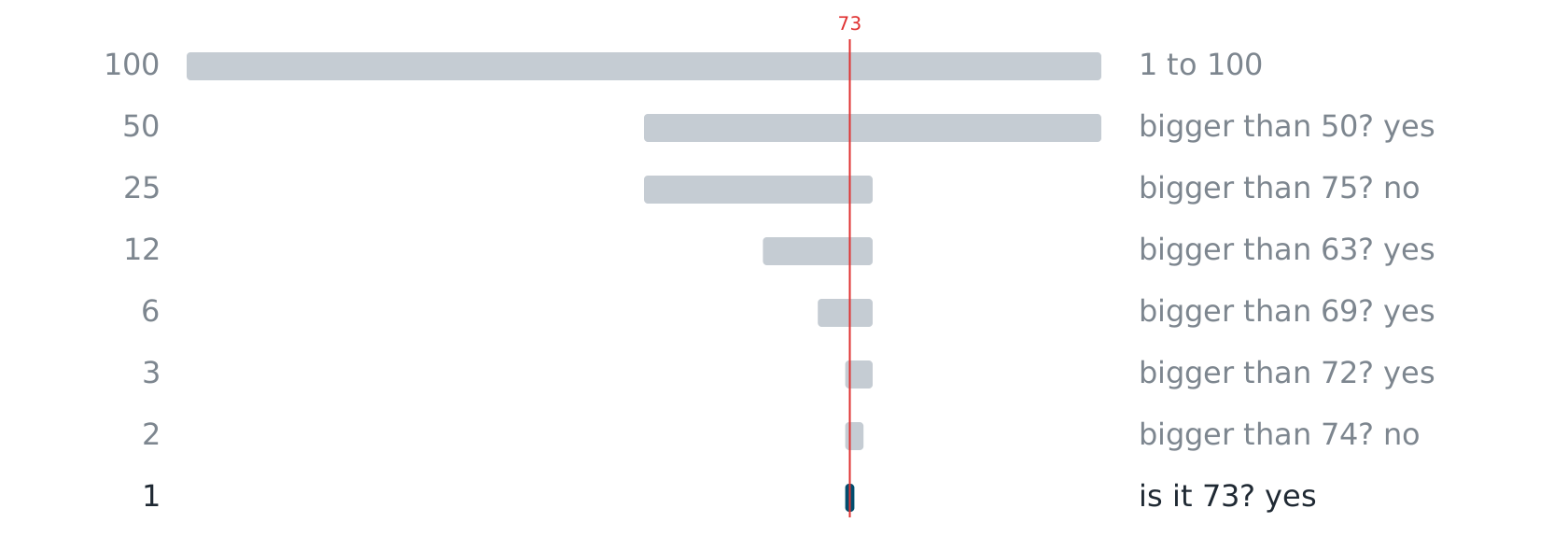
Why it is exactly seven questions has to do with information: every yes-or-no question delivers one bit, and seven bits tell 128 possibilities apart, more than the hundred there are here.
The same trick when something is broken
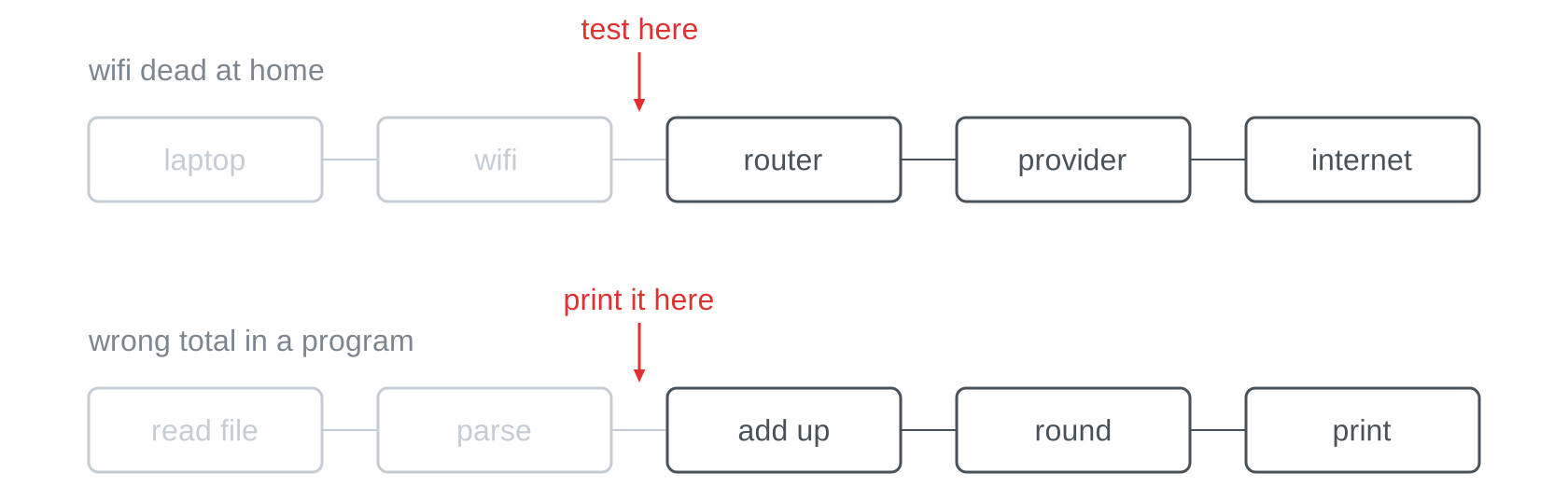
You know this one too. When the wifi is dead, you test in the middle of the chain without thinking about it: if the phone hotspot works, it is not the laptop, and half the suspects are gone. Every test halves the chain. You do the same when a program prints a wrong total: print the value in the middle; if it is right, the fault lies behind it, otherwise before. Whoever has cut well knows not only that something is broken, but where.
Solve a smaller version first
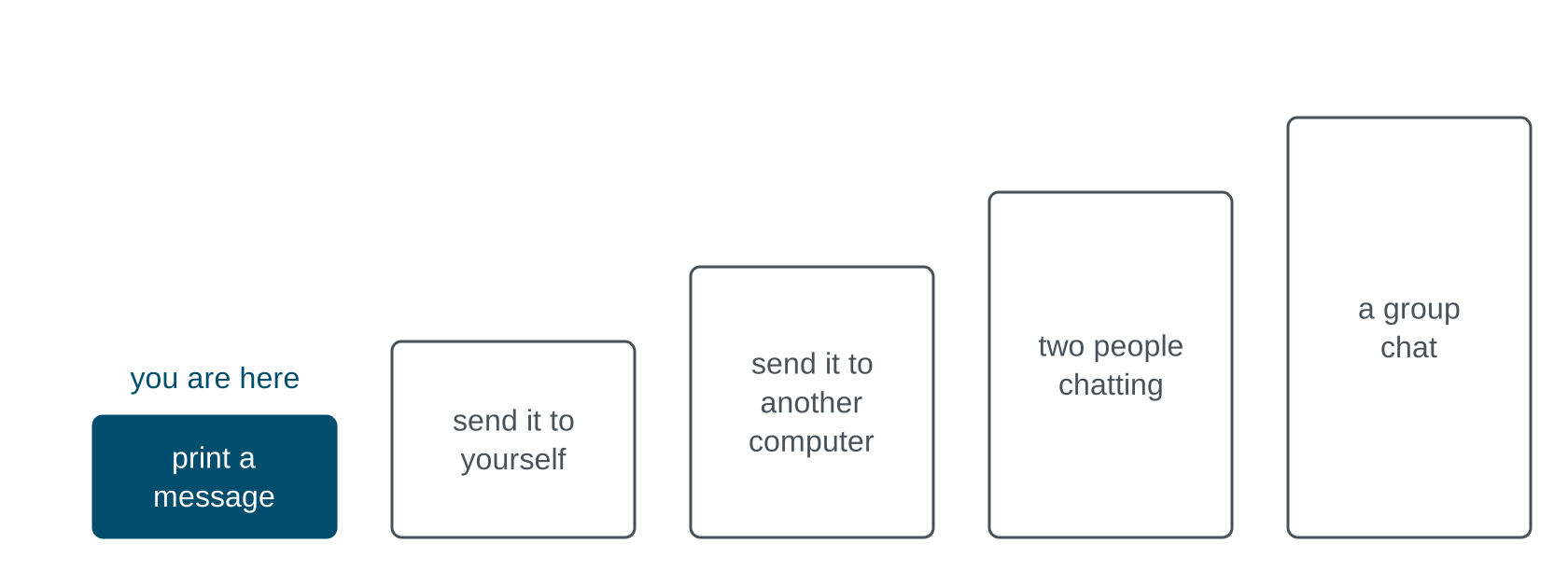
When a problem is too big, solve a smaller version of it that you really can do, and grow from there. Nobody builds a group chat first. You start by printing a message on your own screen, then send it to yourself and after that to another computer, and only at the end do several people chat with each other. Every step is a slightly bigger version of the same problem, and on every one of them something already runs.
A good cut is testable
Cutting alone is not enough, because not every cut is equally good. Compare two sentences: "I need to learn maths" and "I can solve an old exam in 90 minutes". Both sound like exam preparation. With the first one you never know whether you are done; the second one you can try out tonight, and you get a yes or a no. A good piece is one with a test built into it.

In a program it is the same. "The app works" is a feeling. "A wrong password shows an error, 10 times out of 10" is a test that answers yes or no.
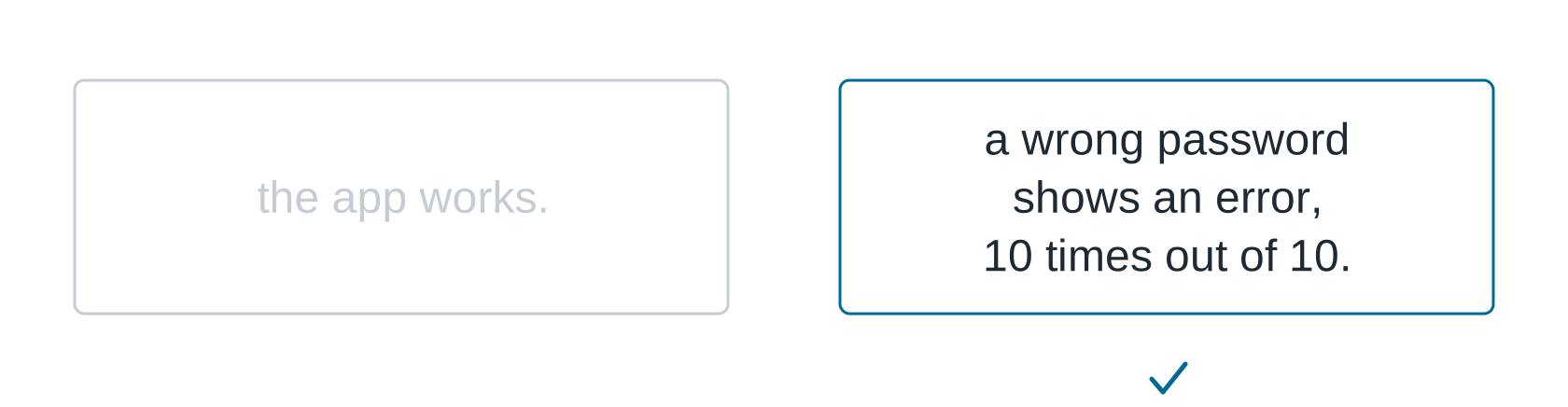
From this follows a simple rule: done means the test passes, not "it looks good". Whoever cuts a task so that every piece has a test of its own does not have to wait for anyone to know whether they are done.
Cuts are agreements
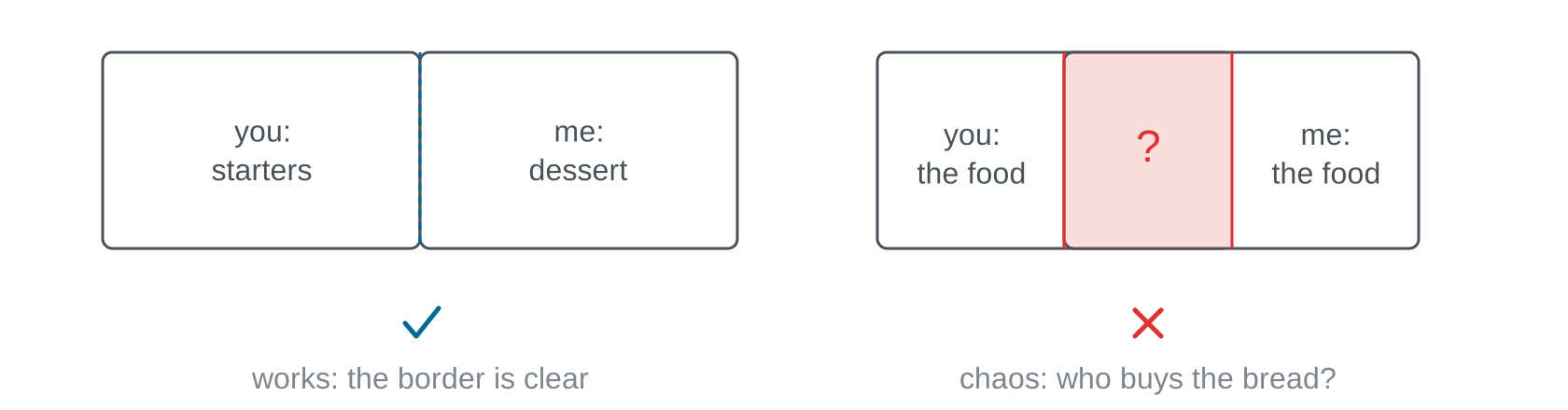
Where you cut decides how much you have to talk. "You do the starters, I do the dessert" works. "We both kind of do the food" turns into chaos, because nobody knows who buys the bread. Pieces work when the border between them is clear, and whatever crosses the border gets written down.
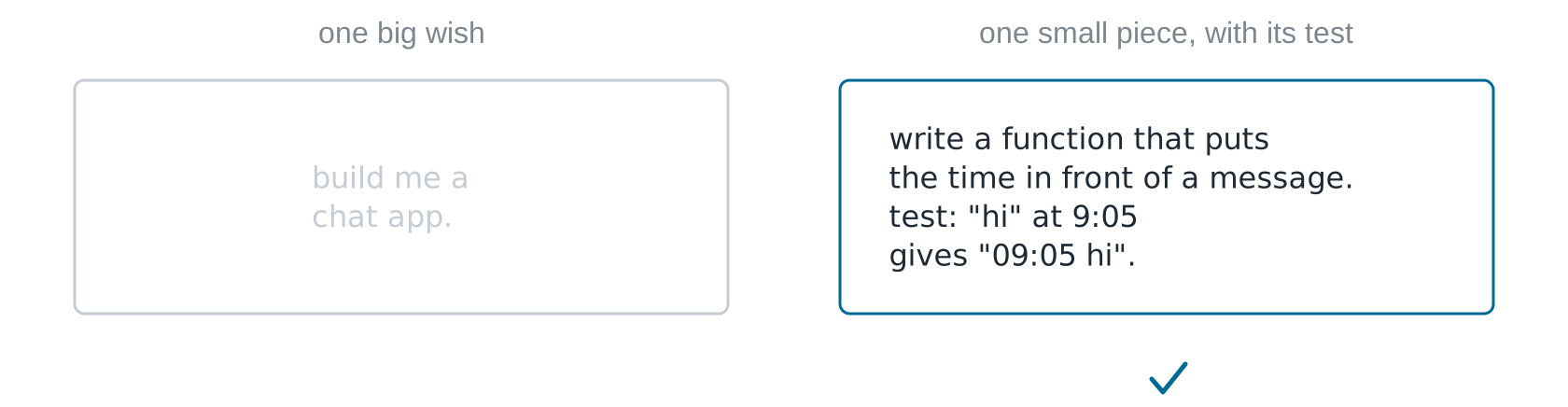
With an AI assistant, cutting is the key skill of all. "Build me a chat app" is one big wish: the assistant cannot do it well, and you could not check the result if it did. A small piece with its test is a different thing. It says exactly what should come out and names the test with it, so you can check the answer in ten seconds without having to believe the assistant.
You cut the problem, the assistant solves the pieces, and you check each one. What a cut piece needs once a computer is supposed to solve it is shown in Solving problems with computers.
How the LiFi project is cut into its challenges, and how you keep cutting in the team, when hunting for faults and with the assistant, is shown in the slides on the project.
Further reading
George Pólya: How to Solve It. Princeton University Press, 1945. The classic on cutting problems, written for mathematics and readable far beyond it: understand the problem, make a plan, carry it out, look back. His questions ("Do you know a related problem?", "Can you solve a part of it?") are the long version of this page.
Details
- Level
- Beginner
- Modules
- Digitization and Programming
- In learning paths
- Python for beginners
- Code
1889- Updated
- 4 November 2026
- Status
- published